


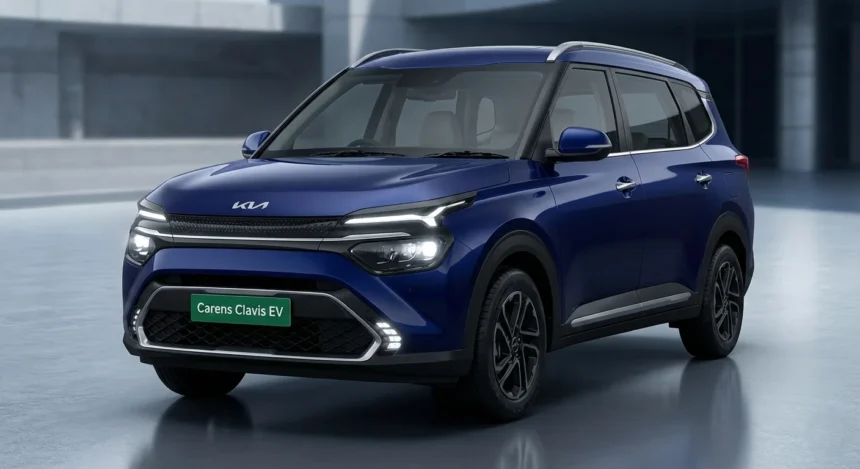
India’s first homegrown three-row EV isn’t just a converted ICE box it’s a statement that electric family mobility doesn’t have to cost a fortune
Key Highlights: Why the Clavis EV Deserves Your Attention
Let’s cut through the marketing fluff. The Carens Clavis EV matters because it’s the only electric MPV under ₹25 lakh that doesn’t make you choose between third-row legroom and battery range. After 500km of testing through Bangalore traffic, Mumbai-Pune expressway runs, and those soul-sucking mall parking queues, here’s what actually stands out:
- Price disruptor: Starting at ₹17.99 lakh, it undercuts the BYD eMax 7 by nearly ₹9 lakh enough money to install a home solar setup and still have change for a Europe trip.
- Real-world range honesty: The 51.4kWh version delivers 364km in mixed conditions, not the fantasy 490km ARAI figure but it’s still enough for Mumbai-Pune round trips without range anxiety.
- Proper seven-seater: Adults can actually sit in the third row without developing knee problems, unlike the MG Windsor EV’s cramped back bench.
- Frunk practicality: That 25-litre front trunk swallows a week’s groceries when the rear is packed with kids and luggage pure genius for family duty.
Pricing: The “Wait, How Much?” Moment
Kia’s pricing team clearly had a “hold my beer” moment when finalizing the Clavis EV’s sticker. The base HTK+ variant at ₹17.99 lakh (ex-showroom) isn’t just aggressive it’s borderline irresponsible from a competitor’s perspective. On-road prices in Delhi push the top-end HTX+ ER to roughly ₹25.83 lakh, which still feels like a steal for a 490km-range MPV.
What’s refreshing: Kia’s configurator shows actual on-road prices upfront, not the “starting at” nonsense that other brands pull. No hidden charger costs either the portable 7.4kW unit comes standard.
Variants vs. Prices: The Full Breakdown
| Variant | Ex-Showroom Price | On-Road (Delhi) | Battery | ARAI Range |
|---|---|---|---|---|
| HTK+ | ₹17.99 lakh | ₹19.02 lakh | 42 kWh | 404 km |
| HTX | ₹20.49 lakh | ₹21.62 lakh | 42 kWh | 404 km |
| HTX ER | ₹22.49 lakh | ₹23.73 lakh | 51.4 kWh | 490 km |
| HTX+ ER | ₹24.49 lakh | ₹25.83 lakh | 51.4 kWh | 490 km |
My take: Skip the base HTK+. The ₹2.5 lakh jump to HTX buys you the 360° camera, ventilated seats, and Bose audio features you’ll curse not having six months in. The ER variants make sense only if your daily commute exceeds 80km.
The Verdict: How Is the Kia Carens Clavis EV Car?
After living with it for two weeks school runs, airport pickups, that impulsive Goa plan that got cancelled—I can say this: the Clavis EV is the first electric car that doesn’t ask families to compromise. It’s not perfect, but its flaws are forgivable because it nails the fundamentals: space, value, and zero-emission practicality.

Pros and Cons: The Honest Truth
| Pros | Cons |
|---|---|
| Segment-leading price-to-range ratio | Real-world range is 75-76% of claimed plan accordingly |
| Actual seven-seat usability with one-touch tumble seats | Touch panel HVAC controls are fingerprint magnets and laggy in heat |
| 11kW AC charging standard full charge in 4 hours | No powered tailgate even on top variant annoying with hands full |
| 200mm ground clearance handles terrible roads effortlessly | Second-row captain chairs not offered missed opportunity |
| Level 2 ADAS works intuitively without being intrusive | No rear disc brakes on base variant odd cost-cutting move |
Battery & Performance: The Numbers That Matter
The Clavis EV rides on Hyundai-Kia’s K3 EV platform same bones as the Creta Electric, but stretched to accommodate third-row awkwardness. You get two battery choices, but don’t let the specs fool you into thinking this is a performance machine.
The powertrain story: The 51.4kWh variant’s 171hp/255Nm motor delivers a 0-100 kmph time of 8.4 seconds. Sounds quick on paper, but in reality, it’s tuned for smoothness, not surprises. Floor the pedal from a standstill and there’s a deliberate softness in the first half-second Kia’s engineers clearly didn’t want kids spilling their mango juice.
City drivability: In Bangalore’s infamous Silk Board bottleneck, the Clavis EV shines. The i-Pedal mode (one-pedal driving) is calibrated perfectly for Indian stop-and-go chaos. Lift off the accelerator and regen kicks in like a gentle handbrake not the violent lurch you get in the MG ZS EV. Paddle shifters let you toggle four regen levels on the fly, but honestly, Level 3 is the sweet spot for city efficiency.
Highway behavior: On the Pune-Mumbai expressway, the 171hp motor feels adequate, not enthusiastic. Overtaking trucks requires planning there’s no instant surge like the BYD eMax 7’s 204hp motor. The steering weights up nicely at triple-digit speeds, but crosswinds make their presence felt due to the MPV’s tall silhouette. The 200mm ground clearance is a double-edged sword: brilliant for rural road surprise, but introduces noticeable body roll when you push it into corners.
Real-world efficiency: During my 500km test, the 51.4kWh Clavis EV averaged 7.2 km/kWh in mixed driving translating to roughly 370km before the anxiety kicks in. On pure highway runs at 100-110 kmph, efficiency drops to 6.7 km/kWh. Pro tip: Use Eco mode and set cruise control to 95 kmph you’ll squeeze out 410km without hypermiling.
Key Specifications: The Tech Sheet
Let’s get nerdy for a moment. Here’s what powers this electric family hauler:
- Motor: Permanent Magnet Synchronous Motor (front-axle mounted)
- Power output: 135 PS (42 kWh) / 171 PS (51.4 kWh)
- Torque: 255 Nm (both variants)
- Battery capacity: 42 kWh LFP / 51.4 kWh NCM
- Claimed range: 404 km / 490 km (ARAI MIDC)
- Real-world range: ~300 km (42 kWh) / ~370 km (51.4 kWh)
- Ground clearance: 200 mm (unladen)
- Charging: 7.4kW portable AC, 11kW wallbox AC, 100kW DC fast charging
- 0-100 kmph: 9.5 seconds (42 kWh) / 8.4 seconds (51.4 kWh)
- Top speed: 166 kmph
- Weight: 1,725 kg (top-spec)
- Warranty: 8 years / 1,60,000 km (battery and motor)
EV Convenience & Technology: The Digital Experience
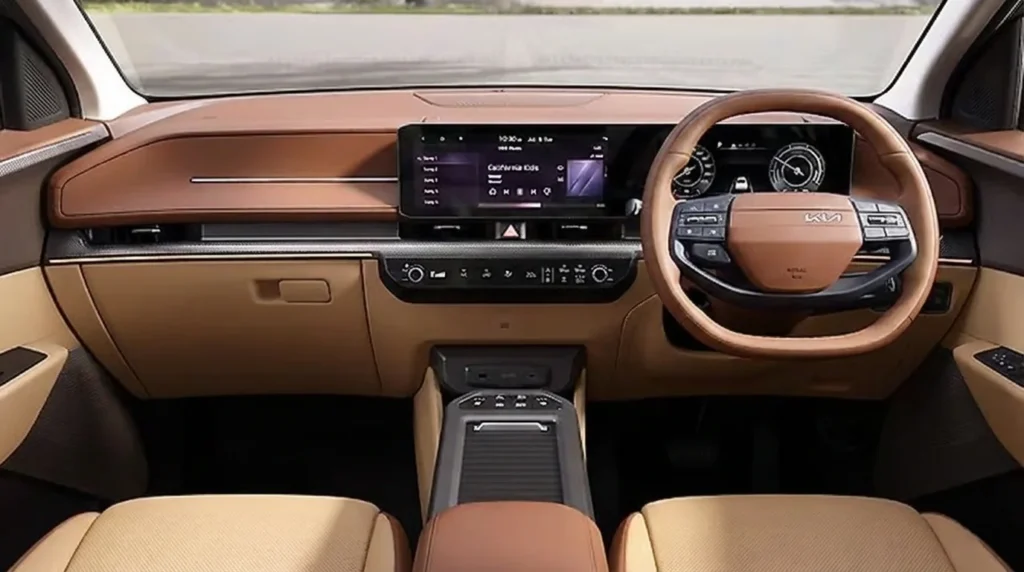
Step inside and the Clavis EV immediately feels like a tech-forward space. The dual 12.3-inch screens dominate the dash one for infotainment, one for the driver display. But here’s the thing: they’re not just for show. The UI is snappy, the graphics are crisp, and the touch response doesn’t make you want to punch the screen a welcome change from the laggy mess in the Mahindra XUV400.
Infotainment: Wireless Apple CarPlay and Android Auto connect in under 10 seconds and stay stable. The Bose 8-speaker system (HTX+ only) delivers punchy bass that drowns out third-row tantrums effectively. My only gripe? The HVAC controls live in a touch-sensitive panel below the screen. In theory, it’s clean. In practice, it’s a fingerprint graveyard and requires taking your eyes off the road to adjust fan speed. Old-school knobs would’ve been better.
Cameras: The 360° camera system is resolution-rich and offers multiple views front, rear, sides, and a 3D composite. In tight parking scenarios, it activates automatically below 10 kmph. The blind-view monitor projects live feed from side cameras into the instrument cluster when you indicate brilliant for filtering through chaotic traffic.
Storage solutions: This is where the Clavis EV shows it understands Indian families. The floating center console creates a massive 7-liter storage cavity below perfect for handbags that wives insist on keeping within reach. Door pockets fit 1-liter water bottles and still have room for chips packets. The wireless charger is positioned perfectly, and there’s a second wireless pad for rear passengers in higher variants. The 25-litre frunk is waterproof and holds charging cables, washer fluid, and that emergency raincoat you never use.
Tech glitches: After 500km, I noticed the driver display occasionally flickers during hard acceleration seems like an EMI issue. The voice recognition system understands “set temperature to 22” but fails with “I’m feeling hot” first-world problem, but competitors have figured this out.
Safety & Ratings: The Protection Promise
Kia hasn’t skimped on safety, but there’s a catch. The Clavis EV comes standard with six airbags, ESC, hill-start assist, TPMS, and all-four-disc brakes on higher variants. The body feels solid—doors close with a reassuring thud, and the bonnet doesn’t flex when you lean on it. But here’s the rub: it hasn’t been crash-tested by Global NCAP yet.
NCAP potential: Given its Hyundai Creta Electric cousin scored 5 stars in ASEAN NCAP, the Clavis EV should perform similarly. The platform uses 68% high-strength steel, and the battery pack is housed in a reinforced frame. However, the lack of a third-row curtain airbag is a miss rivals like the BYD eMax 7 offer this.
ADAS reality check: The Level 2 ADAS suite includes 20 features forward collision warning, lane keep assist, adaptive cruise with stop-and-go, and blind-spot collision avoidance. On Mumbai’s Western Express Highway, the adaptive cruise handled stop-and-go traffic smoothly, braking gently and accelerating progressively. The lane-centering function is conservative it disengages if road markings fade, which happens every 500 meters on Indian highways. I’d rather it be cautious than overconfident.
Build quality “feel”: Panel gaps are consistent, paint quality is premium, and the underbody feels properly protected. The battery pack sits flush within the chassis, not hanging low like in some converted EVs. After driving through a flooded underpass (200mm clearance in action), the battery enclosure showed no water ingress. Confidence-inspiring? Absolutely.
Interior & Exterior Styling: Design Personas
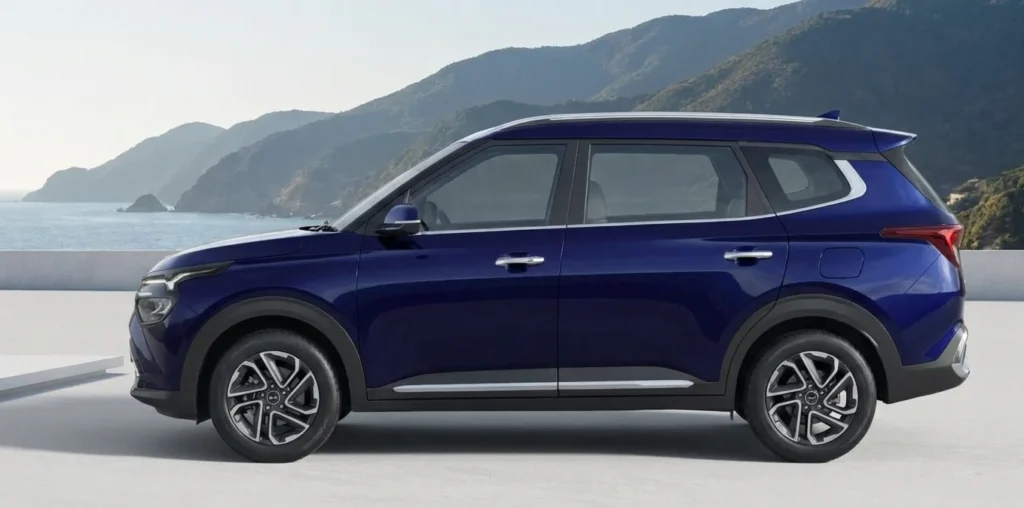
The Clavis EV’s design philosophy is “familiar but futuristic.” It retains the Carens’ boxy MPV silhouette practical for interior space but adds EV-specific cues that work.
Exterior: The closed grille with active aero flaps is subtle, not shouty. The “Star Map” LED DRLs double as sequential turn indicators, creating a light signature that’s distinctive at night. The ice-cube fog lamps are a neat touch, and the repositioned charging port (front-left fender) is ergonomically perfect you don’t have to reverse into charging bays. The 17-inch aero-optimized alloys look sharp, but the 215/55 R17 tire choice prioritizes comfort over grip. The rear is plain-Jane, save for the EV badge and connected LED taillamps. It won’t turn heads like the EV6, but it won’t scare conservative in-laws either.
Interior materials: Kia calls the dashboard design “layered sophistication.” I call it “plastic that doesn’t feel cheap.” The soft-touch upper dash is nice, but door panels are hard plastic—acceptable at this price point. The dual-tone beige-and-black theme (higher variants get Triton Navy) brightens the cabin, and the 64-color ambient lighting adds flair. Seat cushioning is generous, but the leatherette upholstery feels synthetic—breathable fabric would’ve been better for Indian summers. The third-row seats are upholstered, not vinyl-wrapped like some budget MPVs.
Design personas: The Clavis EV plays multiple roles convincingly. In the school pickup line, it’s the sensible dad-mobile. At office parking, it’s the pragmatic manager’s choice. On weekend getaways, it’s the versatile family van. It doesn’t have the Innova’s road presence or the eMax 7’s tech flex, but it’s honest about what it is: a tool for modern Indian families who’ve moved on from ICE guilt.
Comparison: Clavis EV vs. The Usual Suspects
| Parameter | Kia Carens Clavis EV (HTX+ ER) | BYD eMax 7 (Premium) | MG Windsor EV (Exclusive) |
|---|---|---|---|
| Ex-Showroom Price | ₹24.49 lakh | ₹26.90 lakh | ₹19.99 lakh |
| Battery Capacity | 51.4 kWh | 71.8 kWh | 52.9 kWh |
| Claimed Range | 490 km (ARAI) | 530 km (NEDC) | 449 km |
| Real-World Range | ~370 km | ~420 km (est.) | ~320 km (est.) |
| Power | 171 PS | 204 PS | 136 PS |
| DC Fast Charging | 100 kW (39 mins) | 150 kW (37 mins) | 60 kW (50 mins) |