

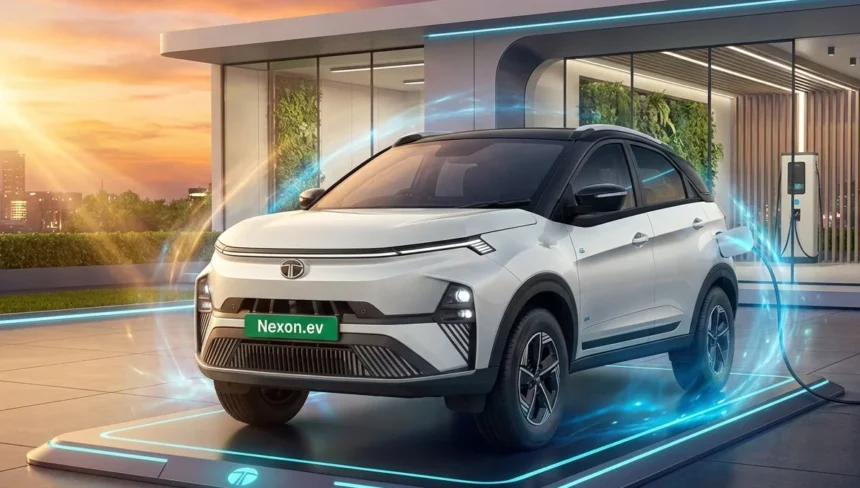
If you’re shopping in the compact electric SUV space, you’re almost certainly looking at this one. This Tata Nexon EV review is written from the driver’s seat after roughly 500 km of mixed use – bumper‑to‑bumper city traffic, expressway stints, a bit of broken-road abuse, and some hill driving.
The short version? It finally feels like an EV that fits everyday Indian life without constant range anxiety… as long as you pick the right battery.
Key Highlights: Why the Nexon EV Works (Mostly)
- Two main personalities:
- 30 kWh MR (Medium Range) – city-biased, budget-friendly commuter
- 45 kWh “45” (Longer Range) – proper inter-city and highway-capable family EV
- Price sweet spot: Starts at ₹12.49 lakh ex-showroom Delhi and tops out around ₹17.5 lakh for loaded 45 kWh trims.
- Real-world range:
- 30 kWh: ~200–220 km mixed use, ~275–290 km if you drive gently
- 45 kWh: ~320–350 km in realistic mixed conditions
- Safety first: Full 5‑star Bharat NCAP rating with strong adult and child protection scores.
- Tech-laden cabin: 12.3‑inch touchscreen (top trims), 10.25‑inch digital cluster, 360° camera, ADAS on high variants.
- Ground clearance & rough-road ability: 190–205 mm, so speed breakers and bad patches aren’t a drama.
- Lifetime battery warranty (select trims): 15‑year “lifetime” warranty for the 45 kWh versions for first owners.
Pricing & Variants: How Much Does the Nexon EV Really Cost?
Tata has turned the Nexon EV lineup into a full family now – multiple trims, two main battery sizes, and a 45 kWh flagship tier.
Official price range:
- Ex-showroom Delhi: ₹12.49 – ₹17.49 lakh (core trims)
- Typical on-road (Delhi): About ₹13.3 – ₹18.4 lakh, depending on variant.
Variant-wise Price Snapshot (Ex-showroom Delhi)
Note: These are representative prices for popular trims; exact figures can vary slightly with revision and dealer/location.
| Variant (EV) | Battery | Positioning | Ex-showroom (approx) |
|---|---|---|---|
| Creative+ MR | 30 kWh | Entry EV, city-focused | ₹12.49–14.49 lakh |
| Fearless / Fearless+ MR | 30 kWh | Better kit, same battery | ₹13.3–16.5 lakh |
| Empowered MR | 30 kWh | Top MR trim | ~₹17.5 lakh |
| Creative / Fearless 45 | 45 kWh | Start of long-range band | ~₹13.99–14.99 lakh |
| Empowered / Empowered+ 45 | 45 kWh | Fully-loaded long-range | ~₹15.99–16.99+ lakh |
On the road, once you add insurance, accessories and state taxes (if applicable), a well-specced 45 kWh trim typically lands around ₹17.5–18.5 lakh in big metros.
Value lens:
- If your running is mostly 75–80 km/day within the city, the 30 kWh MR actually makes financial sense.
- If you do frequent 150–250 km runs (Delhi–Jaipur, Chandigarh–Shimla, etc.), the 45 kWh is worth the stretch purely for lower stress and fewer charging stops.
The Verdict: How Is the Tata Nexon EV As a Car?
Think of the Nexon EV as a regular Nexon that’s learned to relax. The spike‑y power delivery of the old Max has mellowed; everything feels smoother, more mature. It still has enough poke to make gaps in traffic disappear, but it no longer tries to wrench your neck every time you flex your right foot.
In daily use, what stands out most is effortlessness. One‑pedal-ish driving with strong regen in town, near‑silent crawls in traffic, and that clean, instant surge when you’re overtaking at 40–80 km/h.
Pros & Cons at a Glance
| Pros | Cons |
|---|---|
| Strong real-world range with 45 kWh battery | 30 kWh MR can feel tight for frequent highway users |
| 5-star Bharat NCAP rating, 6 airbags, robust structure | Some cabin plastics still feel “hard” for the price bracket |
| Excellent 12.3” touchscreen & high-res 360° camera (top trims) | Touch-only AC panel can be fiddly on the move |
| Comfortable ride, mature high-speed stability | Not the most engaging steering; feels light and vague off-centre |
| Practical 350L boot, 190–205 mm ground clearance | Charging infra outside big cities is still hit-or-miss (not the car’s fault) |
| Lifetime battery warranty on 45 kWh trims | 45 kWh variants push the price close to bigger MG ZS EV range |
If you want one-line advice: buy it as a car first, EV second. It passes that test.
Battery & Performance: What Does It Actually Feel Like On The Road?
Under the floor, you get a front-mounted permanent magnet synchronous motor with two main battery options:
- 30 kWh MR
- 129 PS, 215 Nm
- Claimed range: ~275–325 km
- 45 kWh
- 145–149 PS, 215 Nm (depending on spec)
- Claimed range: 489 km (ARAI/MIDC)
In the real world, those numbers translate differently.
In the city
With Eco or City mode engaged and regen in Level 2 or 3, the Nexon EV feels like it was built for dense Indian traffic:
- Light steering, super-tight length (under 4m) and instant torque mean you’re always a half‑second ahead of that taxi drifting into your lane.
- The new-gen motor has much smoother, more linear power delivery than the old Max – no more sudden thump when you prod the accelerator.
- In slow-moving traffic, you start to drive mostly with your right foot and regen – lifting off becomes your “brake” 70–80% of the time in higher regen levels.
From behind the wheel, you notice how well the regen calibration has been sorted. Level 0 feels like a regular automatic coasting; Level 3 can almost simulate one-pedal driving in town, especially on mild slopes. On a downhill stretch (think the road into the valley around Chamba), you can watch the range climb back up a few kilometres if you’re patient.
On the highway
On an open expressway in Sport mode, the 45 kWh car feels genuinely quick:
- 0–100 km/h in the high‑8 to ~9 second range for the more powerful trims.
- Strong mid-range shove from 60–120 km/h makes overtakes very easy. You don’t need to plan as much as you would in a small turbo‑petrol.
But Tata has clearly tuned this car more for efficiency and stability than outright thrills:
- Past 110–120 km/h, the acceleration starts to gently taper off – deliberately conservative, and honestly sensible for a family EV.
- The cabin remains planted even at 100–110 km/h; crosswinds and truck wake never feel scary, which is not something you can say for every sub‑4m SUV.
Real-world Range: Numbers You Can Actually Live With
Based on instrumented tests and multiple independent runs:
- 30 kWh MR
- Mixed use (AC on, normal driving): ~200–220 km
- Gentle city use: 230–250 km, up to ~275–290 km if you really drive calmly.
- 40.5 kWh (older LR)
- Autocar test mixed range: ~273 km on a full charge.
- 45 kWh
- CarWale & others recorded ~330 km mixed with AC on.
- Many tests and owner logs put realistic mixed range at 320–350 km, with 350–370 km possible if you cruise at 70–80 km/h and aren’t aggressive on the throttle.
The trick is speed. Sit at an easy 80–90 km/h, and the Nexon EV feels like it’ll go on forever. Sit at a true 110+ all day with full-load and AC, and you’ll see the range shrink faster than you expect – like any EV.
Key Specifications: The Hard Numbers
| Item | Tata Nexon EV 30 kWh MR | Tata Nexon EV 45 kWh (Longer Range) |
|---|---|---|
| Motor type | PMSM, single front motor | PMSM, single front motor |
| Power | 129 PS | ~145–149 PS |
| Torque | 215 Nm | 215 Nm |
| Battery capacity | 30 kWh | 45 kWh |
| Claimed range (max) | 275–325 km | 489 km |
| Real-world mixed range | ~200–220 km | ~320–350 km |
| Ground clearance (unladen) | 205 mm (30 kWh) | ~190–205 mm (depending on variant) |
| Boot space | ~350 L | ~350 L |
| Seating | 5 | 5 |
| Drive | Front-wheel drive | Front-wheel drive |
EV Convenience & Technology: Living With It Day To Day
Inside, the Nexon EV feels like a smartphone on wheels – for better and worse.
Infotainment & displays
- Top variants get a 12.3‑inch Harman touchscreen with slick graphics, good brightness and one of the better UIs Tata has shipped so far.
- The 10.25‑inch digital driver display is crisp too, clearly showing range, regen level, and energy flow.
- Wireless Android Auto and Apple CarPlay are supported on higher trims; lower trims get a smaller screen and wired connectivity.
In real use:
- The big 12.3” unit is largely smooth, but you’ll occasionally see a slight lag when jumping between heavy apps like navigation and 360° camera quickly. It’s nowhere near as crash‑y as Tata’s older 10.25” setups, which were notorious for random freezes.
- The 360° camera stands out: high resolution, low lag, usable even at night, and shows side feeds on the screen when you indicate – very handy in tight lanes or blind junctions.
Smart features & connected tech
Depending on variant, you get:
- Connected car suite with remote lock/unlock, AC pre‑cooling, live charging status, geo‑fencing, etc.
- Vehicle-to-load (V2L) and vehicle-to-vehicle (V2V) charging on higher trims – useful if you want to power a campsite or top-up another EV in an emergency.
- Arcade / in-car apps to stream content while charging (best used when parked, obviously).
Storage & practicality
- Plenty of usable cubbies: decent centre console storage with armrest, door pockets, and a usable wireless charging pad in higher trims.
- Boot at ~350 litres is enough for a family’s luggage for a weekend out, though a large stroller + big suitcases will need some Tetris skills.
- The floor isn’t absurdly high despite the battery, so rear passengers don’t sit with their knees to their chin.
Glitches & annoyances
- The touch-based AC panel looks cool but demands your eyes off the road for basic temperature and blower changes. On a bumpy patch, it’s easy to mis‑tap.
- Wireless CarPlay / Android Auto, like almost every car, can occasionally take a second attempt to connect. Not unique to Tata, but worth noting.
- The connected app is feature-rich, but some users have reported occasional delays in live status updates – again, more a backend/network thing than the car itself.
Overall, the day-to-day tech experience is finally “good enough” that you stop thinking about it, which is exactly what you want.
Safety & Ratings: Does It Feel As Safe As The Stars Suggest?
On paper and on the road, this is one of the safest compact SUVs on sale in India.
- Bharat NCAP: 5 stars for both adult and child protection, with 29.86/32 (adult) and 44.95/49 (child) points.
- This rating has been explicitly extended to the 45 kWh variants as well.
Standard or available safety kit includes:
- 6 airbags (front, side, curtain) on higher trims.
- ABS, EBD, ESC, traction control, hill-hold, and hill-descent control.
- ISOFIX child seat mounts, all-seat belt reminders, impact-sensing door unlock, tyre pressure monitoring.
- ADAS features on top trims: Forward Collision Warning, Autonomous Emergency Braking, Lane Departure Warning, Lane Keep Assist, Traffic Sign Recognition, Blind Spot Monitoring, etc.
From the driver’s seat:
- The structure feels reassuringly solid. Doors shut with a proper thump, and over rough patches the body feels more tied-down than many Korean and Japanese rivals.
- At highway speeds, it has the calm, heavy feel of a bigger car; small steering inputs don’t unsettle it, and quick lane changes don’t produce nervous float.
- The brake pedal has a slightly “EV‑blended” feel – regen + friction – but after a day you adapt, and stopping performance is strong.
If you’re upgrading from an older hatchback or compact sedan, this feels like stepping up a class in safety.
Interior & Exterior Styling: What Persona Does It Suit?
Outside
The Nexon EV leans futuristic without being shouty:
- The full-width LED light bar, closed-off grille and aero-style wheels make it look more “EV” than ICE, especially in the brighter colours.
- Signature EV shades like Empowered Oxide, Intensi-Teal, Creative Ocean and Fearless Purple really make it pop in traffic.
- Proportions are still proper SUV: tall stance, chunky cladding, and enough visual mass that it doesn’t look like a hatchback-on-stilts.
This design works brilliantly if you:
- Want something modern and recognisable, but don’t want a polarising “sci-fi pod” like some smaller EVs.
- Drive mostly in cities and want your car to stand out without screaming “look at me”.
Inside
Step in, and the Nexon EV’s cabin feels like a bridge between premium and practical:
- The two‑spoke steering wheel with illuminated Tata logo, dual screens, and floating centre console immediately feel upmarket.
- Top trims get leatherette upholstery, ambient lighting, and ventilated front seats, which genuinely help in hot, humid cities.
- Materials are mostly solid, though you will find hard plastics on lower door sections and certain trim pieces – this isn’t an all-soft-touch Hyundai/Kia rival.
Ergonomically:
- Front seats are supportive with good thigh support. After a full day including some bad patches, your back doesn’t complain.
- Rear seat space is adequate for two adults plus a child. Three full-size adults will fit, but shoulders will be brushing.
- The floor hump is mild, so the middle passenger doesn’t suffer as much as in some rivals.
Persona match:
It suits the young family or first-time EV buyer who wants something that feels aspirational but not fragile. If you live in a hill state like Himachal, the ground clearance, stance and reassuring cabin make it feel “built for our roads”, not imported from a brochure.
Competitor Comparison: Nexon EV vs Mahindra XUV400 vs MG ZS EV
Here’s how the Nexon EV stacks up against two key rivals in India.
| Model | Price band (ex-showroom Delhi, approx) | Battery (largest) | Claimed range (max) |
|---|---|---|---|
| Tata Nexon EV | ₹12.49 – ~₹17.49 lakh | 45 kWh | 489 km (MIDC/ARAI, 45 kWh) |
| Mahindra XUV400 EV | ₹15.49 – ~₹17.69 lakh | 39.4 kWh | 456 km (MIDC, 39.4 kWh) |
| MG ZS EV | ₹17.99 – ~₹20.5 lakh | 50.3 kWh | 461 km (claimed) |
Positioning in plain language:
- Nexon EV: Most affordable, smallest footprint, best city friendliness; 45 kWh narrows the highway-gap to bigger rivals.
- XUV400 EV: More power and torque (up to ~147 bhp, 310 Nm), slightly larger, slightly more range than 30 kWh Nexon but close to Nexon 45 kWh in real use. Cabin and features feel a generation behind.
- MG ZS EV: Bigger, more premium, more space and power (174 bhp, 280 Nm; 50.3 kWh battery). But also significantly more expensive, and not as compact or easy in tight Indian city lanes.
If your budget tops out at ₹17–18 lakh on-road and you want a do‑it‑all EV, the Nexon EV 45 currently hits the strongest mix of range, price, and safety.
Colours & Range: Pick Your Shade, Know Your Real Numbers
Colour Options
Depending on trim, the Nexon EV is available in multiple striking colours like:
- Empowered Oxide
- Pristine White (dual-tone options)
- Intensi-Teal
- Flame Red (dual-tone options)
- Daytona Grey (with black or dual-tone roof)
- Fearless Purple
- Creative Ocean
- Empowered Dark / Carbon Black (on special editions)
If you park on the street in hot climates, the lighter shades (Pristine White, Daytona Grey) will keep the cabin a bit cooler than the darker Dark/Black-style finishes.
Claimed vs Real-World Range
| Variant | Battery | Claimed range (lab) | Typical real-world mixed range (AC on) |
|---|---|---|---|
| 30 kWh MR | 30 kWh | 275–325 km | ~200–220 km; 230–250 km if driven gently |
| Older 40.5 kWh LR | 40.5 kWh | ~390 km | ~273–300 km depending on conditions |
| 45 kWh | 45 kWh | 489 km | ~320–350 km realistic; 350–370 km possible with calm driving |
For hill states and highway users, the 45 kWh is the variant where you stop mentally calculating every detour.
FAQs: Charging & Warranty
1. How long does it take to charge the Tata Nexon EV at home?
- With the standard 3.3 kW AC charger (15A socket):
- 30 kWh: roughly 8–10 hours from ~10–100%.
- 45 kWh: around 16–18 hours on a basic 15A plug, though most 45 kWh owners opt for a faster wallbox.
- With a 7.2 kW AC wallbox (often bundled with higher trims):
- 30 kWh: about 4–4.5 hours from ~10–100%.
- 40.5/45 kWh: roughly 6–6.5 hours from ~10–100%.
Overnight charging at home is absolutely realistic; you plug it in after dinner and it’s full by morning.
2. What about DC fast charging – how quick is 10–80%?
Using CCS2 DC fast chargers:
- 30 & 40.5 kWh variants:
- 10–80% in about 56 minutes on a 50 kW DC charger.
- 45 kWh variants:
- 10–80% in roughly 40 minutes on a 60 kW charger.
These figures assume the charger can actually deliver stated power and the battery is in an optimal temperature window – in the real world, expect a few minutes either side.
3. What is the battery warranty on the Tata Nexon EV?
There are two layers here:
- Standard warranty (all modern Nexon EVs):
- Battery & motor: 8 years / 1,60,000 km (whichever is earlier).
- Vehicle warranty: 3 years / 1,25,000 km.
- Lifetime battery warranty (select 45 kWh trims):
- For the 45 kWh Nexon EV, Tata has rolled out what it calls a “lifetime” battery warranty, which in Indian terms means 15 years from date of first registration for the first owner, with unlimited kilometres.
- For a second owner, coverage typically reverts to 8 years / 1,60,000 km window.
- You must service the car at authorised Tata workshops and avoid tampering/damage to remain eligible.
Always cross-check the specific warranty booklet of your car, as schemes can vary by batch and time of purchase.
4. Is frequent fast charging bad for the Nexon EV’s battery or warranty?
Tata doesn’t void your warranty just because you use DC fast charging regularly, as long as:
- You use approved CCS2 chargers.
- You don’t physically damage the connector or battery pack.
- You follow normal usage & service schedules.
However, like any lithium-ion pack, constant fast charging from very low SOC to very high SOC will, over long periods, stress the cells more than gentle AC charging. The practical approach:
- Use home AC charging (3.3–7.2 kW) for daily top-ups.
- Reserve DC fast charging for highway runs or when you’re short on time.
Do that, and with the 8-year base warranty + lifetime scheme on 45 kWh trims, the battery should be the least of your worries.
If you’re an early EV adopter who still wants a car that feels familiar, solid and India-ready – not a science experiment – the Tata Nexon EV, especially in 45 kWh form, is exactly that middle ground.